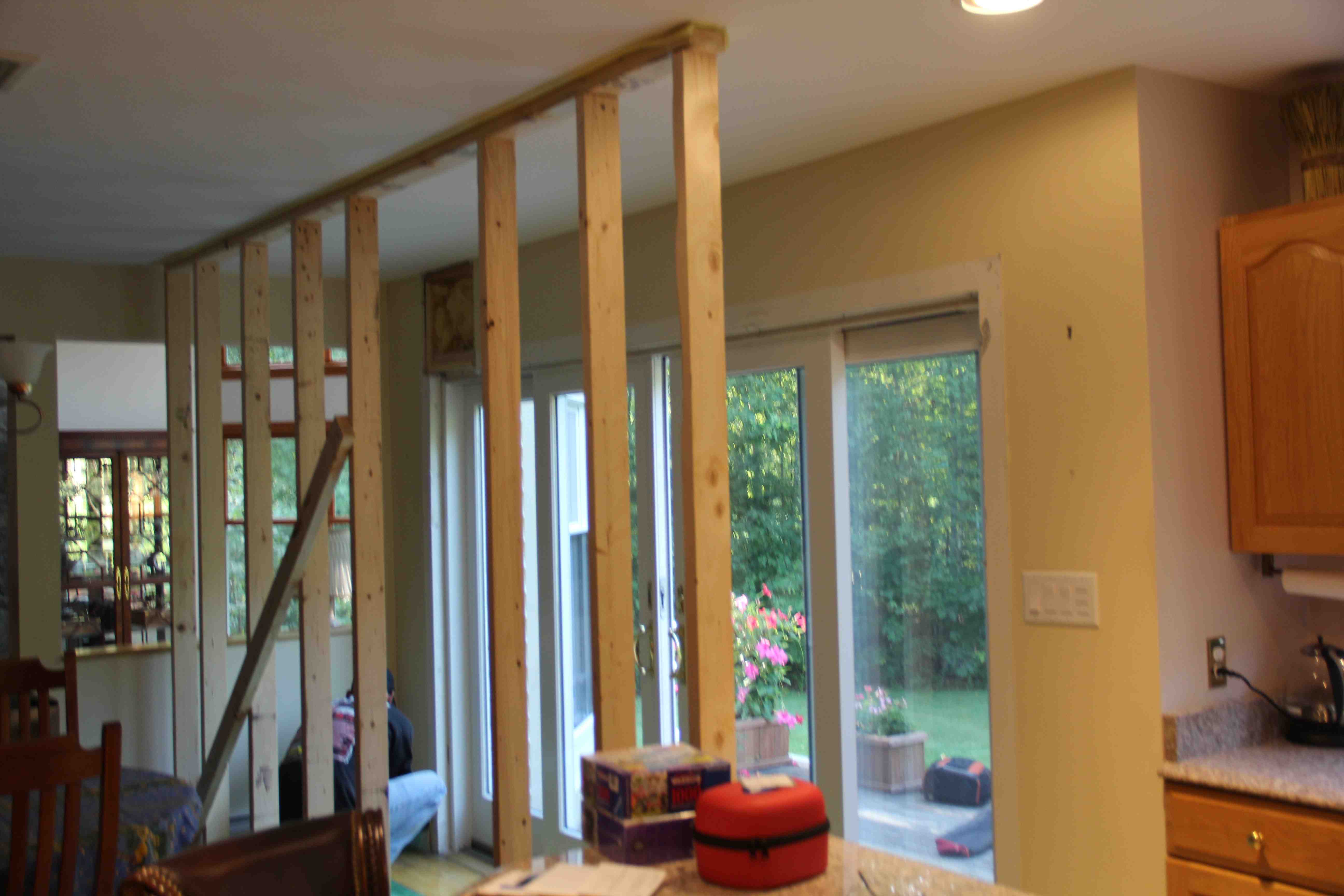
Top horizontal member of a frame wall supporting ceiling joists rafters or other structural members.
Temporary support wall stud spacing.
Jack studs and king studs.
Shoring may be spaced at 3 to 4 5m spacing to cover longer length of the bar.
Use the same type lumber as the rotted studs.
There are different ways to provide support but if the joists above are perpendicular to the wall the easiest option is to build a temporary brace wall.
Building codes dictate the required wall stud spacing depending on the type and location of the wall.
If it is i need to support the structure temporarily while the demolition and rebuilding work are done.
Using the proper distances is essential to meeting building codes and getting the necessary wall support.
Matching the exact length of the studs is vital.
Lay out the stud locations on the edge of the bottom runner using a permanent marker and a length of wood that equals the stud spacing.
This temporary wall supports the overhead structure when removing an existing load bearing wall to.
Add 2 by 4 lumber to a 2 by 4 stud wall or 2 by 6 lumber for a 2 by 6 stud wall.
Flying shores is a system of providing temporary supports to the party walls of the two buildings where the intermediate building is to be pulled down and rebuilt figure 4 and 5.
A header is a simple beam sized to support the load above the opening it spans.
Stud distances is an important part of the building or remodeling process.
Large openings in the wall are made for windows and doors.
Extreme how to shows how to build a temporary brace wall.
The first step is to determine if the wall is load bearing.
If the new stud is too short it will not support the plate and roof.
If the new stud is too long it will push the top plate up and can affect the roof position.
You don t need to mark the upper runner.
Wall studs are an important part of any stick frame building giving vertical support to upper stories and roofing if it is a load bearing wall and simply creating separation of rooms in a partition wall.
When the opening is greater in width than the stud spacing and most windows are wider than 24 in.
All types of arrangements of supporting the unsafe structure in which the shores do.
Check for 24 inch on center spacing between any studs you do locate and that may solve the case of the missing stud.
Typical stud spacing is 16 inches on center and even on older houses is rarely greater than 24 inches on center.
Most electrical boxes for switches or outlets are attached to a stud on one side.